Microscope.ai organizes prompts into four main categories, each designed to monitor different aspects of your AI presence. Understanding these categories helps you build comprehensive monitoring strategies.
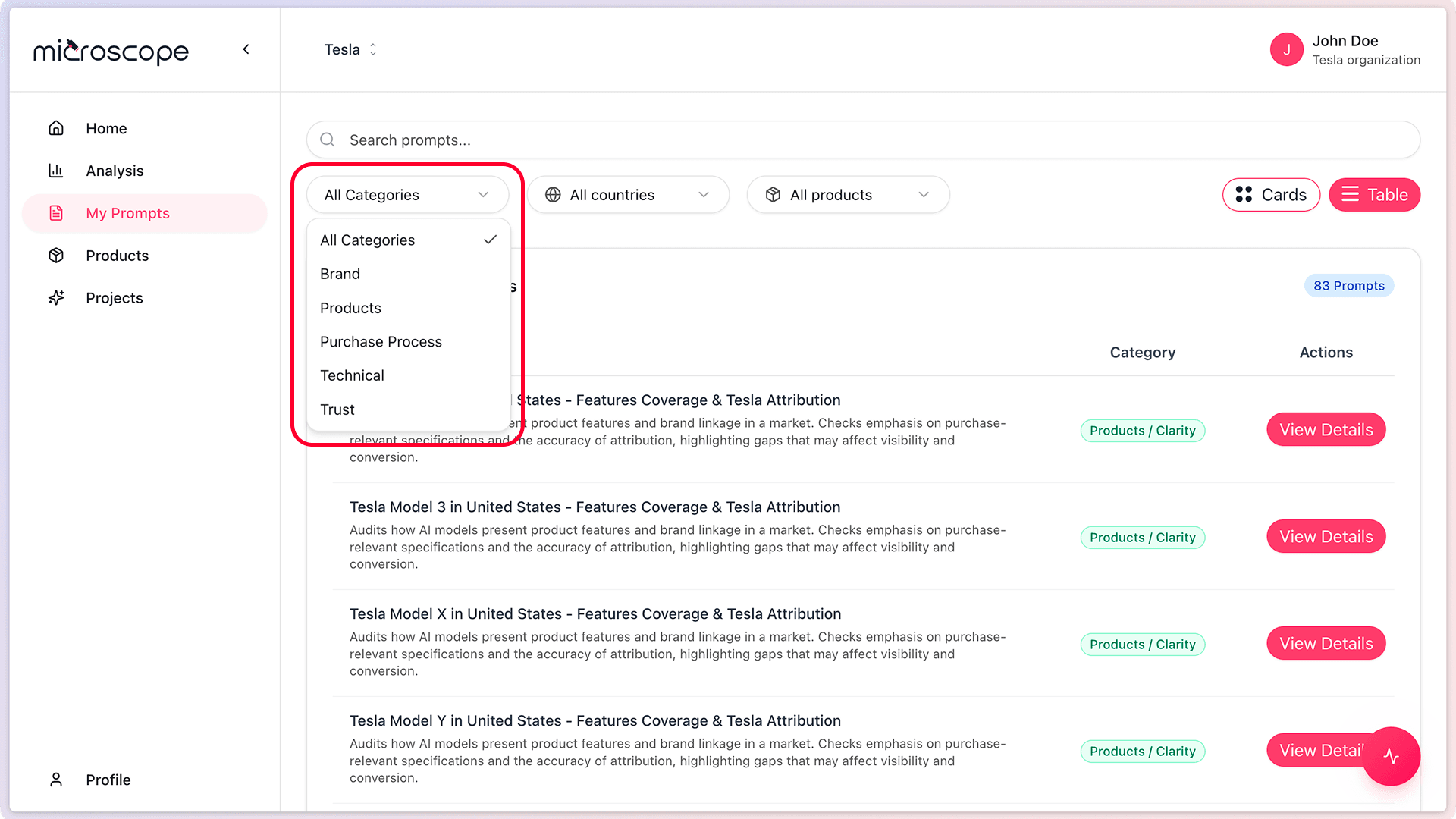
Why Categories Matter
- Provide structured insights into different business areas
- Help organize your monitoring efforts
- Enable category-specific performance tracking
- Facilitate balanced analysis across all aspects
- Simplify reporting and communication
Brand Category
Brand prompts focus on overall brand awareness, recognition, and reputation in AI responses.
What Brand Prompts Measure
- Brand awareness - How well AI models know your brand
- Brand recognition - Whether AI mentions you in relevant contexts
- Brand positioning - How you're described relative to competitors
- Brand attributes - What characteristics AI associates with your brand
- Brand reputation - How favorably AI represents you
Example Brand Prompts
- "What is [Brand Name] known for?"
- "Tell me about [Brand Name]"
- "Who are the leading companies in [Industry]?"
- "Compare [Your Brand] to [Competitor]"
When to Focus on Brand Prompts
- Building initial brand awareness
- After rebranding initiatives
- During competitive positioning campaigns
- Monitoring brand reputation
- Tracking brand evolution over time
Product Category
Product prompts target specific products or services in your catalog.
What Product Prompts Measure
- Product recommendations - How often AI suggests your products
- Product descriptions - How accurately AI describes features and benefits
- Product comparisons - How you rank against competitive products
- Product use cases - Whether AI understands when to recommend your products
- Product availability - Whether AI knows where to find your products
Example Product Prompts
- "What is the best [product type] for [use case]?"
- "Compare [Your Product] to [Competitor Product]"
- "Where can I buy [Product Name]?"
- "What are the features of [Product Name]?"
When to Focus on Product Prompts
- Launching new products
- Optimizing product pages
- Improving product visibility
- Monitoring product-specific campaigns
- Tracking competitive product positioning
Product prompts work best when you have a well-maintained product catalog with accurate descriptions and use cases.
Technical Category
Technical prompts assess how well AI understands and communicates technical aspects of your offerings.
What Technical Prompts Measure
- Technical accuracy - Whether AI gets specifications right
- Implementation details - How AI describes technical setup or use
- Compatibility information - Whether AI knows what works with your products
- Technical requirements - If AI communicates prerequisites correctly
- Support and documentation - Whether AI directs users to technical resources
Example Technical Prompts
- "What are the system requirements for [Product]?"
- "How do I integrate [Product] with [Other System]?"
- "What programming languages does [Product] support?"
- "What are the technical specifications of [Product]?"
When to Focus on Technical Prompts
- For technical products or SaaS
- When technical accuracy is critical
- Monitoring developer-facing products
- Ensuring implementation guidance is correct
- After product updates or new releases
Trust Category
Trust prompts evaluate how AI models represent your credibility, reputation, and reliability.
What Trust Prompts Measure
- Reviews and ratings - How AI represents customer feedback
- Company reputation - Whether AI knows about awards, recognition
- Reliability - If AI mentions stability or track record
- Customer satisfaction - How AI describes customer experience
- Authority - Whether AI recognizes you as an industry leader
Example Trust Prompts
- "Is [Brand Name] reliable?"
- "What do customers say about [Brand Name]?"
- "What awards has [Brand Name] won?"
- "How does [Brand Name] compare in customer satisfaction?"
When to Focus on Trust Prompts
- Building brand credibility
- After receiving industry recognition
- Monitoring reputation
- Addressing trust concerns
- Highlighting customer satisfaction
Using Categories Strategically
Balanced Monitoring
For comprehensive insights, include prompts from all categories:
- Brand - 30% of prompts
- Product - 40% of prompts
- Technical - 15% of prompts
- Trust - 15% of prompts
Adjust percentages based on your specific priorities.
Category-Specific Analyses
Create focused analyses using one category:
- Deep dive into product positioning
- Technical accuracy audit
- Brand awareness campaign tracking
- Reputation monitoring
Interpreting Category Results
Category Scores
Microscope.ai may provide category-level scores showing:
- Performance in each category
- Strengths and weaknesses
- Areas needing attention
- Comparative performance across categories
Category Trends
Track how each category performs over time:
- Improving categories - Where optimization is working
- Declining categories - Where attention is needed
- Stable categories - Maintaining performance
- Category correlations - How categories influence each other
Custom Categories
Some advanced plans may allow creating custom categories:
- Organize prompts by campaign
- Group by geographic market
- Segment by audience type
- Create project-specific taxonomies
Next Steps
With a solid understanding of prompt categories, you're ready to:
- Create custom prompts in specific categories
- Build category-focused analyses
- Interpret category-level results
- Optimize based on category insights