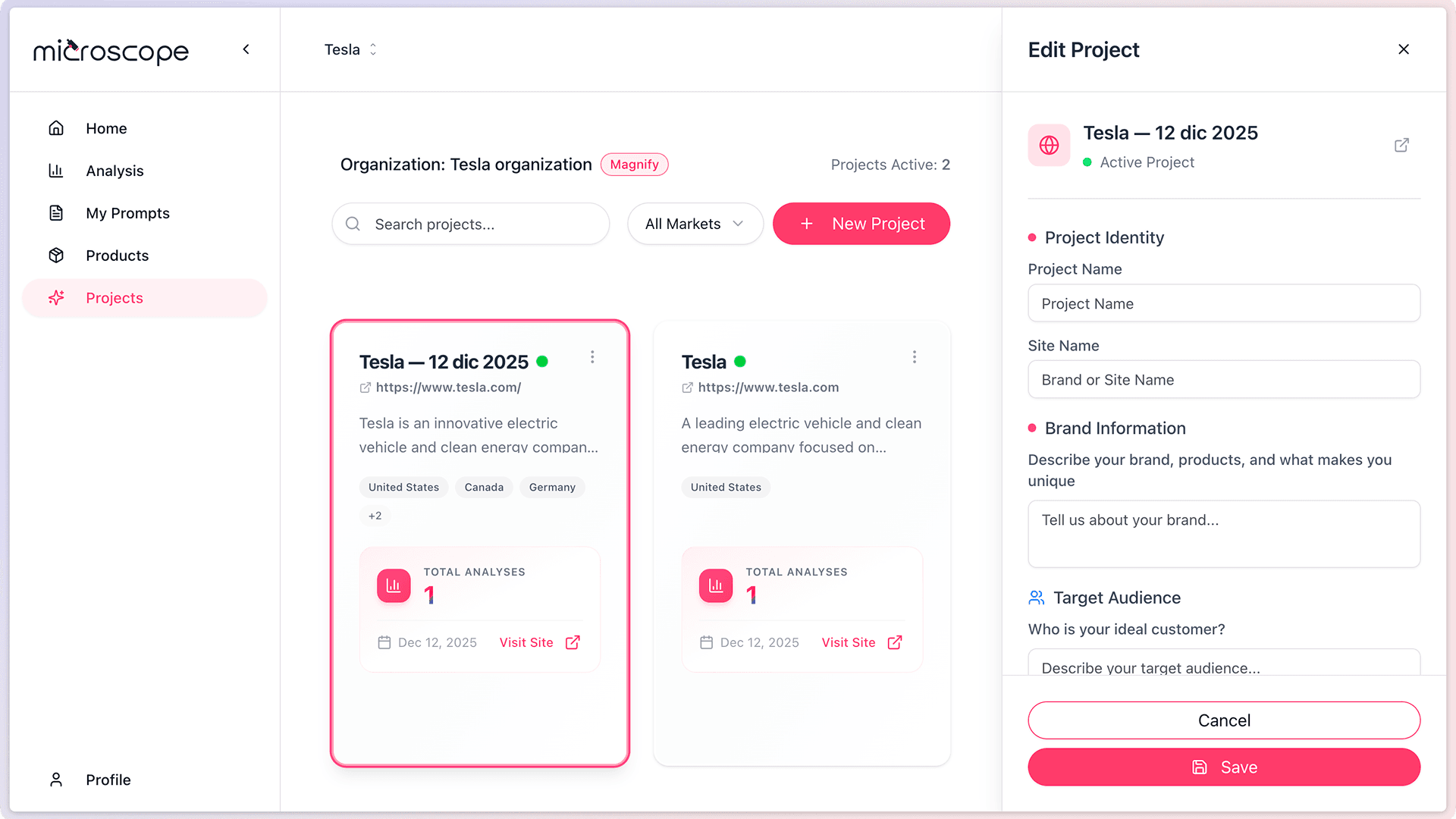
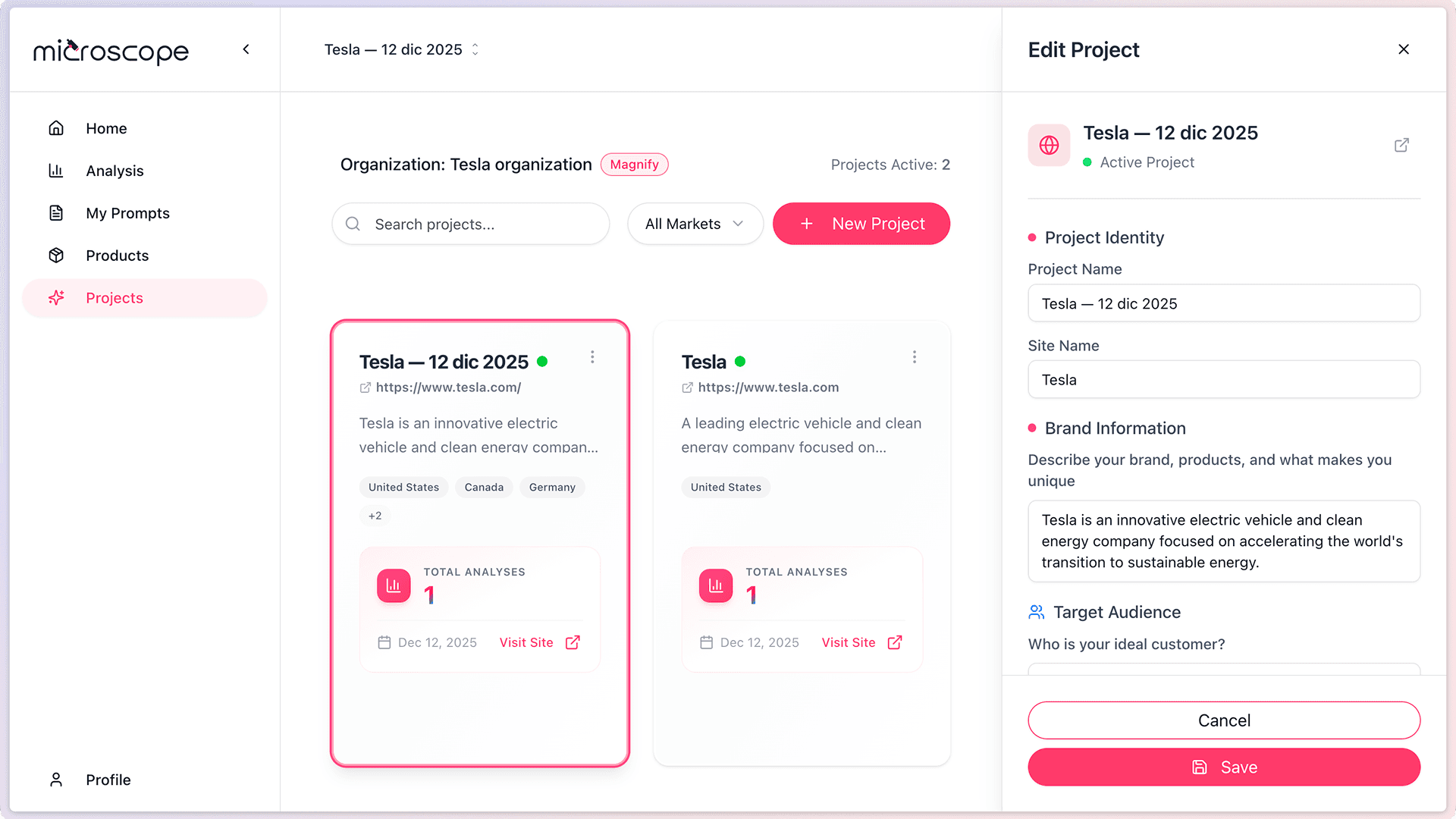
Brand information is the foundation of accurate AI monitoring in Microscope.ai. The more comprehensive and precise your brand data, the better the platform can evaluate how AI models represent your brand. This guide walks you through providing complete brand information.
Why Brand Information Matters
AI models use brand information to:
- Understand what your brand does and offers
- Evaluate accuracy of AI responses
- Identify missing or incorrect information
- Compare your positioning against competitors
- Assess brand awareness and recognition
Incomplete brand information leads to less accurate analysis and missed insights.
Brand Name
Official Brand Name
Enter your official, legal brand name:
- Use proper capitalization
- Include special characters if part of the official name
- Avoid abbreviations unless that's how you're known
- Be consistent with your website and marketing materials
Doing Business As (DBA)
If you operate under a different name:
- Add your DBA or trade name
- Include regional variations
- List subsidiary brand names
Brand Description
What to Include
Write a comprehensive description covering:
- What you do - Core products or services
- Who you serve - Target audience and market
- How you're different - Unique value proposition
- Your mission - Why you exist
- Your positioning - How you want to be perceived
Writing Tips
- Be clear and specific, not vague
- Use language your customers would use
- Focus on benefits, not just features
- Keep it factual and objective
- Aim for 150-300 words
Think of your brand description as what you'd want an AI assistant to tell users when they ask about your brand.
Target Audience
B2B vs B2C
Specify your business model:
- B2B - Selling to businesses
- B2C - Selling to consumers
- B2B2C - Selling to businesses who serve consumers
- Both - Dual market focus
Audience Demographics
For B2C brands:
- Age range
- Income level
- Geographic location
- Lifestyle characteristics
- Shopping behavior
For B2B brands:
- Company size (SMB, Mid-Market, Enterprise)
- Industry sectors
- Job titles and roles
- Decision-maker characteristics
- Buying process
Brand Values and Mission
Core Values
List 3-5 core values that define your brand:
- Quality
- Innovation
- Sustainability
- Customer service
- Affordability
- Transparency
Mission Statement
Your brand's purpose and goals:
- What problem are you solving?
- Who are you helping?
- What change are you creating?
- What future are you building toward?
Brand Positioning
Competitive Positioning
How you position yourself in the market:
- Premium vs. budget
- Innovation leader vs. reliable standard
- Specialist vs. generalist
- Challenger vs. established player
Key Differentiators
What sets you apart:
- Unique features or capabilities
- Superior customer service
- Better pricing or value
- Specialized expertise
- Brand heritage or story
Product and Service Categories
Main Categories
List your primary product or service categories:
- Use industry-standard terminology
- Include both broad and specific categories
- Note any emerging product lines
Key Products or Services
Highlight your most important offerings:
- Best sellers
- Flagship products
- Award-winning services
- Newest innovations
Brand History and Milestones
Foundation and Growth
- Year founded
- Founder story
- Key milestones
- Expansion history
- Major achievements
Awards and Recognition
- Industry awards
- Certifications
- Media recognition
- Customer testimonials
- Third-party validation
Geographic Presence
Markets Served
Where you operate:
- Countries
- Regions
- Languages
- Local adaptations
Physical Presence
- Headquarters location
- Office locations
- Retail stores
- Distribution centers
Brand Personality and Voice
Brand Personality
How your brand "sounds":
- Professional vs. casual
- Serious vs. playful
- Traditional vs. modern
- Warm vs. authoritative
Tone of Voice
Language characteristics:
- Formal vs. conversational
- Technical vs. accessible
- Enthusiastic vs. measured
- Direct vs. nuanced
Updating Brand Information
Review and update regularly:
- Quarterly for fast-growing brands
- Annually for established brands
- Immediately after major changes (rebrands, new products)
- When expanding to new markets
Best Practices
- Be honest - Don't exaggerate or mislead
- Be specific - Vague descriptions don't help AI analysis
- Be consistent - Match your website and marketing
- Be current - Keep information up to date
- Be complete - Fill all relevant fields
Next Steps
With comprehensive brand information, you're ready to:
- Configure website settings
- Add products to your catalog
- Review automatic prompts
- Create custom prompts
- Run your first analysis