Understanding how Microscope.ai works will help you get the most out of the platform and interpret your results effectively. This guide explains the complete analysis process from start to finish.
The Analysis Process
Microscope.ai follows a systematic process to evaluate your brand's presence in AI-powered search results:
Step 1: Prompt Creation
The platform uses prompts (questions) that simulate real user queries. These prompts can be:
- Automatic Prompts - Pre-built questions covering essential areas like brand recognition, product information, technical details, and trust signals
- Custom Prompts - Questions you create based on your specific business needs and target audience
Step 2: AI Model Querying
Each prompt is sent to multiple AI models simultaneously, including:
- GPT (OpenAI)
- Gemini (Google)
- Claude (Anthropic) - Coming soon
- Perplexity AI - Coming soon
Step 3: Response Collection
The AI models generate responses just as they would for real users. Microscope.ai captures these responses and stores them for analysis.
Step 4: Analysis and Scoring
The platform analyzes each response to measure:
- Brand Mentions - Whether your brand was mentioned
- Position - Where your brand appears in the response
- Accuracy - Correctness of information provided
- Completeness - How thoroughly your products are covered
- Competitiveness - Your position relative to competitors
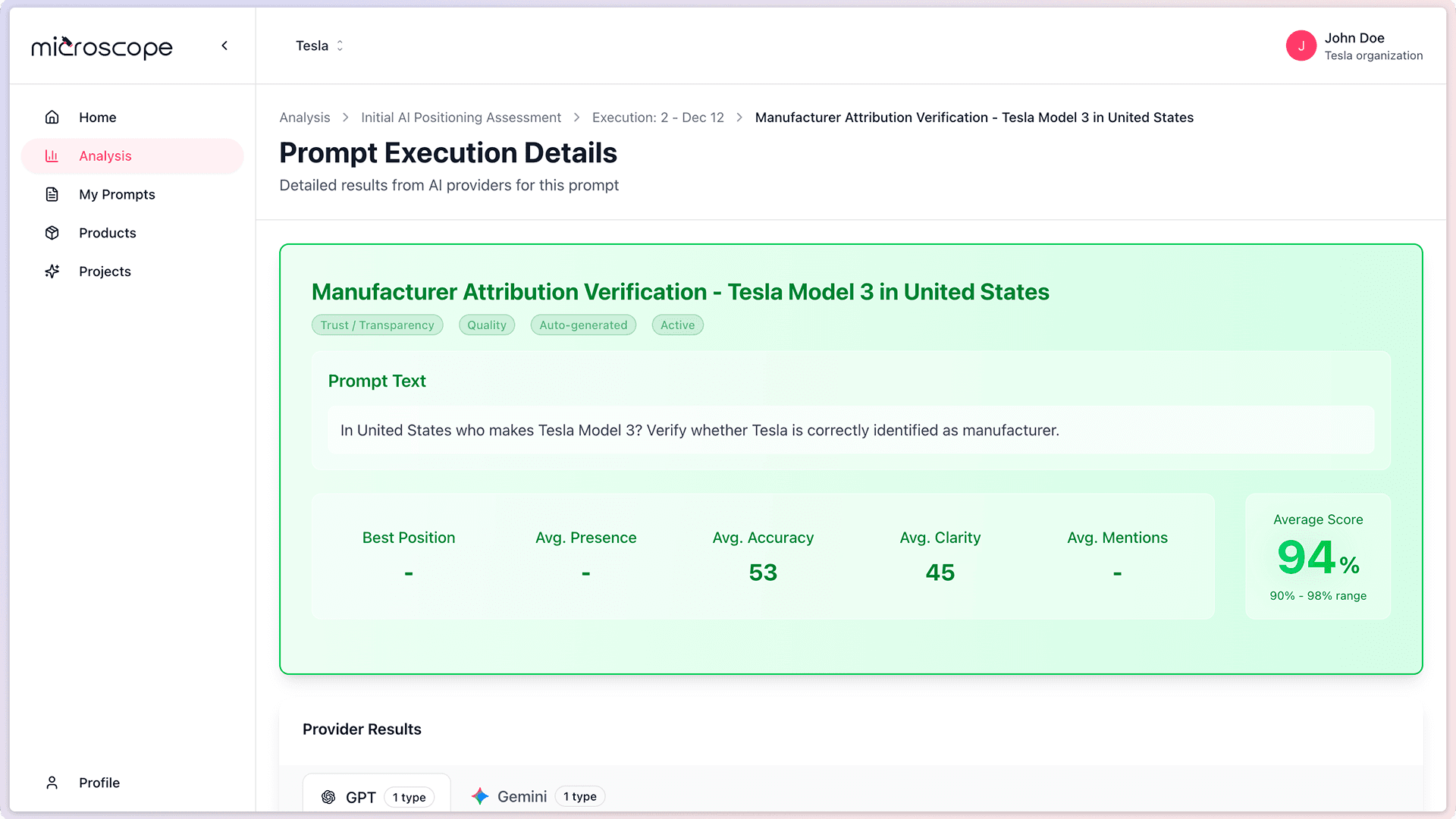
The Platform Hierarchy
Microscope.ai is organized in a hierarchical structure that helps you manage complex monitoring scenarios:
- Organization - The top-level entity representing your company. It contains all users, projects, and billing information
- Projects - Separate initiatives for different brands, websites, markets, or business units
- Products - Your product catalog that provides context for product-related analyses
- Prompts - The questions used to query AI models (both automatic and custom)
- Analyses - Collections of prompts executed together as a unit
- Executions - Individual runs of an analysis at a specific point in time
- Results - Detailed outcomes for each prompt showing scores, AI responses, and insights
Why This Structure Matters
This hierarchy allows you to:
- Monitor multiple brands or markets independently
- Compare performance across different product lines
- Track changes over time with scheduled executions
- Organize team access by project or area
The Complete Workflow
Here's how a typical analysis flows through the platform:
- Setup - Create a project and add your products to establish context
- Configure - Select or create prompts that match your objectives
- Schedule - Set up one-time or recurring analysis executions
- Execute - The platform queries AI models and collects responses
- Analyze - Automated scoring and insights generation
- Review - Examine results through the dashboard and detailed views
- Optimize - Take action based on insights to improve your AI presence
- Monitor - Track improvements through recurring analyses

Types of Insights Generated
Performance Metrics
Quantitative measurements of your AI search performance:
- Overall scores by category
- Mention rates across models
- Position rankings
- Trend indicators over time
Competitive Intelligence
Understanding your position relative to competitors:
- Competitive mention frequency
- Relative positioning in responses
- Share of voice across queries
Actionable Recommendations
Specific suggestions for improvement:
- Content gaps to address
- Technical optimizations needed
- Product information to enhance
- Priority areas for focus
Continuous Monitoring
One of the most powerful aspects of Microscope.ai is its ability to track changes over time through automated, recurring analyses.
Benefits of Recurring Analyses
- Track Progress - Measure the impact of your optimization efforts
- Catch Issues Early - Identify problems before they affect your business
- Understand Trends - See how AI models' understanding of your brand evolves
- Benchmark Performance - Compare periods to understand what works
Recommended Schedule
The ideal analysis frequency depends on your goals:
- Daily - For active optimization campaigns or competitive markets
- Weekly - For general monitoring and trend tracking
- Monthly - For established brands with stable presence
Next Steps
Now that you understand how Microscope.ai works, you're ready to:
- Learn about key concepts and terminology
- Explore user roles and permissions
- Create your first project